
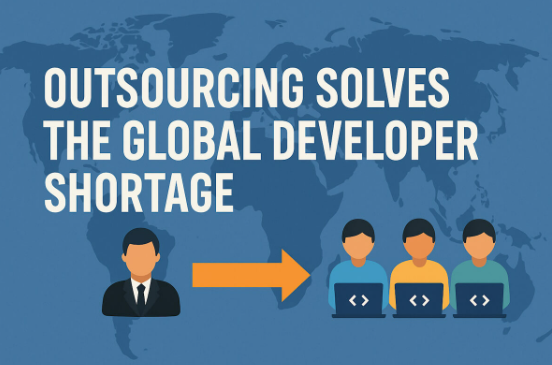
Every company wants to build fast, scale smart, and launch on time. But what if you can’t even hire the people to make that happen?
That’s the exact problem thousands of businesses are facing across the globe — there’s a massive shortage of software developers. And no, it’s not just a temporary dip. This has been brewing for a while.
There just aren’t enough qualified engineers to meet the growing demand. And while salaries keep rising, timelines keep stretching. It’s no longer just about finding talent. It’s about finding it fast, affordably, and without losing your mind in the process.
That’s where software development outsourcing steps in and fixes a whole lot more than just resourcing.
Let’s break it down.
The Developer Shortage Is Real (And It’s Not Going Away Anytime Soon)
First, let’s not sugarcoat it — this developer shortage is hitting companies hard. From early-stage startups to Fortune 500s, everyone’s in the same boat.
Hiring locally has become a pain. Competition is brutal. Skilled devs get poached in weeks. And junior candidates need months of ramp-up time.
Some stats to chew on:
- In the US alone, there are hundreds of thousands of unfilled tech jobs.
- Many developers receive multiple offers within days of job hunting.
- Projects get delayed simply because there’s no one to build them.
This isn’t about bad hiring practices. It’s just simple supply and demand. There are more tech projects than there are developers.
Now, some companies are turning to in-house training or bootcamp grads — which helps, but it’s slow and doesn’t solve short-term delivery issues.
Why Outsourcing Is No Longer Just a Cost-Play
A few years back, outsourcing was all about saving money. You’d ship off work to another country, hoping it gets done for half the price.
That’s changed.
Today, software development outsourcing is about accessing skills you can’t find locally. It’s about scaling up without waiting months. It’s about building faster, without sacrificing quality.
Outsourcing teams are not just code factories. They’re experienced engineers, product thinkers, UI experts, DevOps folks — the whole deal.
You’re no longer outsourcing just tasks. You’re outsourcing capabilities.
And that’s a big shift.
The Global Talent Pool: Why Limit Yourself?
Think about it. Why restrict your hiring to a 30-mile radius around your office?
Great developers exist in every corner of the world. And many of them are working remotely anyway. So if your team’s on Zoom and Slack, does it really matter if someone is dialing in from Chicago or Buenos Aires?
Outsourcing gives you access to this global talent — folks who’ve worked on real-world products, who understand deadlines, and who’ve solved complex problems before.
You’re not settling for second-best. You’re just broadening the pool.
And if your in-house team is swamped, outsourcing can fill the gaps without burning out your people.
Speed Is Everything
Hiring a full-time developer takes time. Interviews, negotiations, onboarding, ramp-up — the whole thing can take months.
By the time you fill one position, the project may already be behind.
With outsourcing, you can spin up a team in a couple of weeks. Sometimes faster. And because these devs are already trained, you don’t have to start from scratch.
They jump into sprints, pick up stories, and start shipping.
That kind of speed is a game-changer when your product roadmap is packed and your customers aren’t exactly waiting patiently.
Cost-Smart, Not Cheap
Outsourcing doesn’t mean cutting corners. It means spending wisely.
Sure, rates might be lower depending on where your outsourcing partner is based. But that’s not the point.
The real savings come from time — faster delivery, fewer delays, and no long hiring cycles.
Also, you’re not paying for idle time. You scale the team up or down based on workload. No need to hire full-time staff for short-term spikes.
That flexibility matters. Especially when budgets are tight and expectations are sky-high.
Quality Isn’t the Issue — Management Is
One of the biggest myths about outsourcing? That the quality will suffer.
Truth is, good developers exist everywhere. The real issue is how you manage the work.
If you treat your outsourcing team like a separate unit, you’re going to have problems. But if you treat them like part of your team — with shared goals, open comms, and regular check-ins — they’ll deliver just as well, if not better.
Use the same tools. Join the same stand-ups. Give them context, not just tickets.
That’s how good outsourcing works.
Not Just Developers — Access to Tools and Tech
Most outsourcing partners offer more than just devs.
Need UI/UX design? Covered. DevOps? Handled. QA? Included.
It’s a one-stop shop for most of the pieces you’d need to launch or maintain a product. You don’t have to juggle multiple vendors or spend weeks finding freelancers.
You work with one team, and they bring the rest.
That’s especially helpful when you’re juggling deadlines and can’t afford bottlenecks.
Hiring Isn’t Just About Resumes Anymore
Here’s where things get even more interesting.
With tools like an ai hiring tool, companies are trying to fast-track the hiring process. These platforms screen candidates, run assessments, and even analyze cultural fit.
But even with tech helping out, you still need a deep pool of candidates to work with. And right now, that pool is shallow — at least locally.
Outsourcing widens the pool. And if your outsourcing partner uses an ai hiring tool internally to vet their own team, that’s a bonus. You’re essentially getting pre-vetted talent with less risk.
So you can skip the guesswork and get straight to work.
What About Security and IP?
Let’s get real. Data privacy, IP rights, and code ownership are major concerns. And they should be.
But the best outsourcing firms already know this. They work with contracts, NDAs, and security policies that protect your product and your business.
Plus, a lot of them are already working with companies in fintech, healthcare, and other sensitive industries. They know how to handle compliance and security.
So it’s not as risky as it might seem — as long as you do your homework and choose the right partner.
Final Thoughts: You’re Not Falling Behind — You’re Just Hiring Wrong
If you’re still struggling to hire developers the old-school way, you’re going to feel stuck.
Outsourcing isn’t some workaround. It’s a legit strategy to deal with a very real problem.
You don’t need to keep fighting over the same small talent pool. There’s a whole world of developers ready to go — you just need to tap in.
Use software development outsourcing to boost your speed, get the talent you need, and stop worrying about missed deadlines. And if your partner’s using tools like an ai hiring tool to build their own team, that’s even better for you.