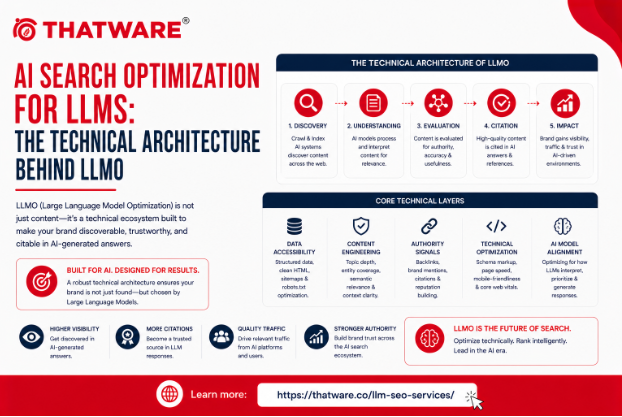
Most discussions of LLM SEO focus on content strategy and brand authority. But underneath all of it is a technical architecture layer that often determines whether content strategy investments actually translate into AI citations. Understanding the technical side of LLMO is foundational strategic knowledge for any brand making significant investments in AI search visibility.
How Language Models Process Web Content
There are two primary mechanisms through which language models encounter and process web content: training data ingestion and real-time retrieval.
Training data ingestion is the process by which the model learns from a large corpus of text. Content that was widely available, clearly structured, and frequently referenced at training time has more influence on the model’s baseline understanding of topics and entities.
Real-time retrieval is what happens when a model with web access pulls current information to answer a query. Here, the model is making active decisions about which sources to retrieve and cite — influenced by signals that look like traditional authority signals but with semantic and extractability dimensions added.
Structured Data as Foundation
The most technically impactful intervention for AI search optimization for LLMs is structured data implementation. Schema markup gives language models clear, machine-readable signals about what your content is, who it’s about, what entities it references, and how it relates to adjacent topics.
The most relevant schema types for LLM optimization include: Organization (entity definition), Article (content classification), FAQPage (Q&A extraction), HowTo (instructional content). Implementation should be validated for semantic accuracy — the schema should describe what the content actually is.
Entity Graph and Knowledge Graph Considerations
Language models use entity graphs — networks of named entities and their relationships — to make sense of complex topics. Getting your brand clearly represented as an entity, with clearly defined relationships to your industry and expertise areas, is a foundational technical investment.
An AI LLM optimization agency with strong technical depth will have specific processes for entity establishment and consistency maintenance across sources that influence knowledge graph construction.
Semantic Architecture of Content
Beyond page-level structured data, the semantic architecture of your entire content library matters. How do your content pieces relate to each other? Is the topical hierarchy clear? Are there explicit links between related concepts? Is content organized around questions that users actually ask?
Technical Accessibility and Crawlability
AI systems that do real-time retrieval need to be able to access and parse your content. Pages that are heavily JavaScript-dependent, slow to load, or technically inaccessible may be skipped in favor of more easily parsed alternatives. Technical SEO fundamentals — Core Web Vitals, clean HTML structure, clear heading hierarchy — matter for LLM retrieval just as they do for traditional SEO.